You are currently logged-out. You can log-in or create an account to save favorites and more. more info
Embracing Impermanence Through Meditation
AI Suggested Keywords:
The central thesis of the talk focuses on the theme of impermanence, especially in relation to fear, meditation practices, and dealing with pain and loss. It discusses the teachings of the Buddha on impermanence and encourages acknowledging and embracing fear during meditation as a path to understanding and liberation. The narrative emphasizes the importance of being present in the moment, breaking down intense emotions into manageable parts, and using meditation to explore one's inner landscapes in the face of mortality. Additionally, the talk highlights practical meditation strategies, like using the Medicine Buddha practice, to manage physical pain and emotional turmoil.
Referenced Works:
- Who Dies? by Stephen Levine: The book contains a chapter on pain that offers meditative techniques similar to those discussed in the talk for dealing with physical pain through mindfulness and presence.
- The Wisdom and Compassion exhibit: Referenced concerning a painting of the Buddha's parinirvana as a depiction of joy and liberation, highlighting the range of responses to impermanence and death.
- NPR interview mention: Used as an example of how distraction and thoughts about the future can impair present-moment awareness, illustrated through an Olympic athlete's experience.
AI Suggested Title: Embracing Impermanence Through Meditation
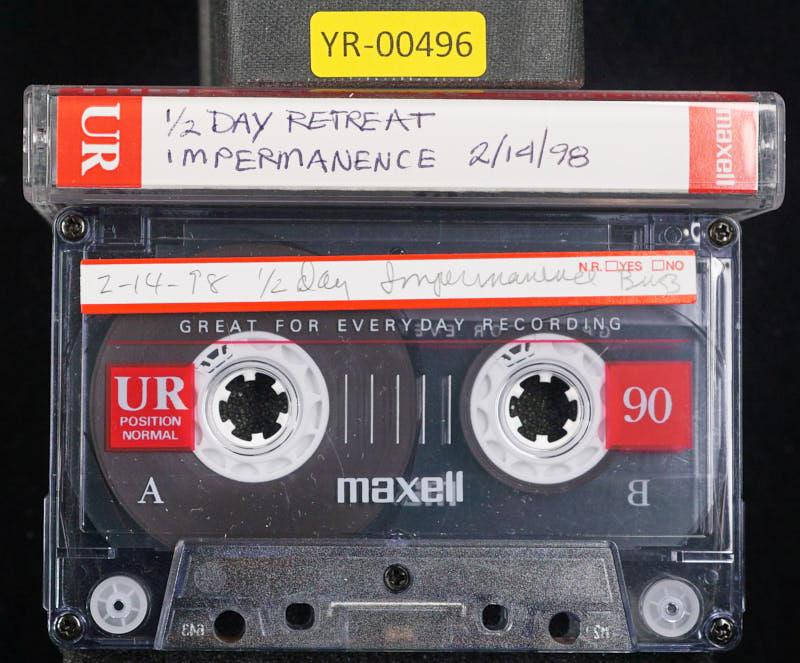
Side: A
Possible Title: 1/2 Day Retreat - Impermanence
Additional text: Buzz
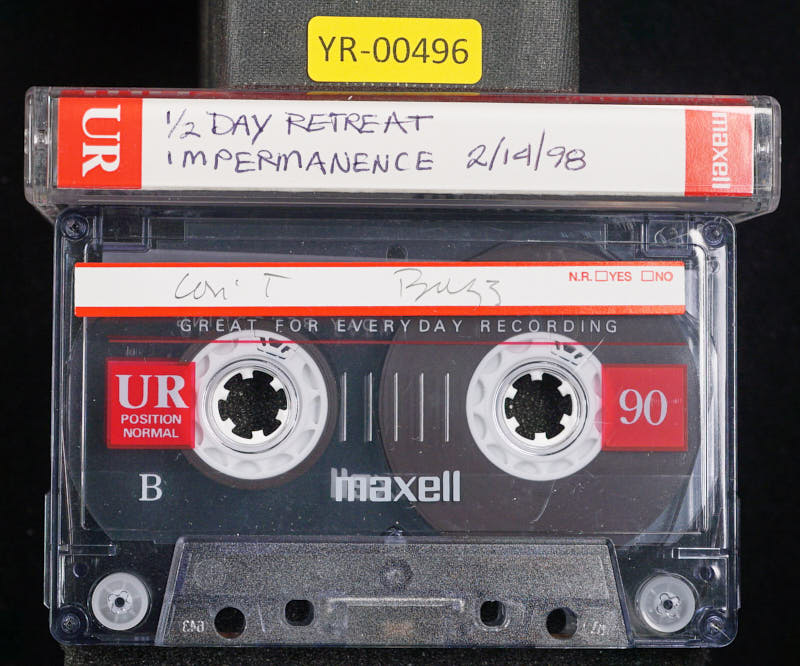
Side: B
Possible Title: Contd
Additional text: Buzz
@AI-Vision_v003
First, I want to thank those of you who have expressed concern about our flooding. And my apologies for not realizing that doing a flood report or weather report may be useful. Thank you, Betty, for thinking of it. Also, I want to say how glad I am to see you. So we have our great theme of the year, impermanence. I started to take this bouquet of yellow roses that someone brought a couple of days ago away. And Carol said this morning, oh, I thought it was an intentional meditation on impermanence. baby back onto the altar.
[01:33]
Heaven forbid that we should take it apart just because the roses are turning brown and the petals are falling off. Tomorrow is the day in the Buddhist world that is conventionally the marker for the Buddhists entering nirvana, part of nirvana of the Buddha. So Bill and I hung the thangka that's there on the wall, the Buddha in the middle, and with the gold background, it has all the scenes from the Buddha's life, which are all classical focuses for meditation. But I think the great teaching really comes from And some of you, I think, have seen paintings of the Buddha's dying and seen all of his disciples in various poses indicating the range of reactions from a couple of monks with their robes pulled over their heads, weeping, sobbing, and others of the disciples meditating or teaching or doing walking meditation in a cave or whatever it is, doing their practices.
[02:57]
what the Buddha encouraged everyone to do on the eve of his passing. To continue that it was not the Dharma that was done. And to really acknowledge and honor what each of the disciples knew from their own practice and from their years of studying with him. And of course in the whole contemplation of impermanence, the big meditation for virtually everybody has to do with the meditation So I want to talk a little bit about fear and with respect to this territory of practice.
[04:08]
Because no matter what we think about our capacities, there will be some impermanence And we don't know. We can't say with confidence, oh, I don't do that. And in fact, it is foolish of us to get too confident about our ability to meet both minor and major values. Because when we get too complacent, when we have a kind of false confidence, we aren't paying attention what's actually so for us. And if we are practicing, if we are practiced in knowing how to be with fear, then we don't have anything to be afraid of.
[05:19]
Even the fear itself becomes an occasion Most of us suffer enormously and have a great deal of fear arise around some dying which we didn't expect. And how much of our not expecting dying, the fading away of whatever arises, is because we delude ourselves, we lull, we have a kind of lulling I just got a call yesterday from a woman who lives in New York who has just been given a terminal diagnosis. And along with that diagnosis, the doctor's speculation, educated guess that she won't live very long.
[06:27]
And I could hear the fear in her voice. She said, I will fly to California for an hour to talk to you. That's all you pay. Grasping and clinging at somebody who will save her. And I, of course, am very happy to talk to her and to give her some Most of us living in the culture that we live in don't appreciate how much benefit there is from having a little warning. A little warning goes a long way.
[07:34]
No matter how close to the passing away, a little warning gives us a chance to say, oh, I just forgot, and to get to work. to attending that which everything in our habituated mind, our conditioned mind, wants to turn away from. Whether it be the passing away of a dear friend, of a job, of a situation that we had great confidence and hope about, of our own passing away of this body which we become so attached to and so accustomed to. I want to remind you that a lot of the possibility in being with whatever
[08:44]
emotion arises for you around mortality, around dying, around passing away. Whatever emotional ground you begin to have some direct awareness of can be the ground that you can cultivate some capacity to be with. but you need to be skillful in the way you do it. That's why the last time we met I was talking about really knowing something about the ground and the tension and what distracts you. This is the point where being very clear about what your resources are can be of enormous importance. Because if you have some confidence about your meditation practices and you know what practices actually are effective in settling and calming, in your being able to be present, then you can do it.
[09:55]
And this is not to say that you need to be present for long stretches of time. It counts to be present for a moment. And in fact it may be skillful especially with very strong and intense fear, to be present, to explore the possibility of being present with that intense fear, but not for too long. Maybe no more than an inhalation, or an inhalation and an exhalation. way of inching your way toward what feels bigger. When very intense emotion comes up, to let it be broken up into smaller elements. So you don't try to work with really enormous emotional states before you've begun to develop some capacity and consequently some confidence in working with the emotions that arise in small ways and in brief ways.
[11:19]
As I've been working with the focus on impermanence myself, I've been struck by how much fear arises when I have thoughts that go towards the future. And how often I hear from other people that they're fine as long as they stay in the present moment, but how much trouble they get into when they think about five minutes from now or an hour from now. It's very useful to notice when fear arises, the particularity of the thought that you have this response of fear to. Because often it's a thought. Often it's a sequence of thoughts called a story.
[12:20]
On NPR recently, there was an interview of one of the Olympic contenders. I don't even remember now what his particular... I don't know if it was snowboarding or... I think it might have been snowboarding. I was so caught by his description and his state of mind, I didn't pay attention to it. when he was dealing with his body, but it had something to do with hurtling downhill fast. He said just before he was ready to take off, to start, the thought came up, what am I going to say to the journalists down at the finish line? Isn't that great? And he said he was so preoccupied with thinking about what he was going to say to the journalists at the finish line that he didn't pay attention to his start.
[13:37]
So he came in fourth. And he said, it was completely clear to me that I came in fourth because I wasn't paying attention to where I was at the moment, moment by moment. He got it. you know, athletic lug out there on the mountains doing this crazy thing of going down the hill. And he got this great dharma teaching just like that. Of course, the question is, how deeply, how penetratingly will the teaching drop? We'll see. He seemed like he'd really gotten it. And what was so interesting to me was that he was not beating himself up. He was more kind of He was really interested in, you know, actions have consequences, including the actions of thought, of thinking, of where we place them on.
[14:43]
So much for light flame as it is working. It burns. I'm very interested in what we hear and see as news, what gets reported to us as newsworthy. I'm continually interested in not only what gets reported, but what doesn't get reported. Some of you may remember some years ago I told the story about a a man who was on a bus in Delhi, the town of the rioting after Indira Gandhi's assassination. This was a piece that he'd written some ten years after the fact. And his point was, good news doesn't make it to the newspapers because it doesn't sell.
[15:51]
So I've been, as I think some of you know, I tend to read the newspapers when they're It helps that I read them faster and I don't get caught by quite as much junk. But I have been looking in the reports about the Olympics to see if I can find a description of the opening ceremony where a very young man who works with detonating or dismantling landmines, and who in the process of his work lost an arm and a leg, was the person who carried the torch around the stadium before it was taken up to light this year's flame. And the friend who watched the opening ceremony was on television, imitated this guy doing this kind of rolling walk because of this artificial money.
[16:58]
And how moving it was that that resume had been chosen there before. Seems to me that should be just front page headlines, this hot. It's almost as though we don't dare to let ourselves read about, or hear about, or know about those human stories where people are, for some wider good, putting themselves, literally, their lives on the line. Here is a young man whose work is a continual meditation on troubles. And I think we have something to learn from him. Part of what I imagine makes it possible for him to do what he does is because his intention is bigger than just himself.
[18:09]
And in the whole range of literature on impermanence meditations, there is lots of advice about the usefulness of the breadth of focus. That when we have some sense about the nature of the problem, it's marking everything and every being. And we know the specifics of that. We know, for example, thousands of people died in the earthquake in Armenia. Again. For me, keeping in mind, dedicating my daily practices to the safe passing over of those people who died suddenly, and in many ways we can't begin to know, to do prayers on their behalf, helps me find some way to encourage myself to do the same meditation for myself and those close to me, where there's more stickiness.
[19:26]
It helps me keep in perspective that this is indeed one of the marks that identifies and is characteristic of whatever is born, whatever has beginning has end. So it's extremely important when we do meditations on impermanence that we not get stuck on either the macro or the micro, that we keep stretching mental capacity to focus on impermanence as we see it in the tiniest detail in one of those roses in the vase of welfare. One second of awareness about the weather or state of mind. Whatever is close in and to also be balancing with some attention So I want to reiterate for all of us that it's important that we know what our ground is.
[20:49]
It's important that we know what is home base and that we have developed and continually cultivated and attended home base with some regular practice that brings us back to being centered and grounded and as present, as full of attention in the moment as possible. Because out of that will come some skill in knowing how to work with whatever arises when we do an impermanence meditation where we have some strong, maybe even surprising, upwelling. To not be surprised when that happens. To not have some attachment to being a cool Buddhist. Of course, what we immediately come back to is, what's my intention as a practitioner?
[22:10]
If my intention is to look good, if my intention is to hide, if my intention is to find some skillful ways or apparently skillful ways to bury what I don't know how to be with, I'm just creating a kind of hell room for myself. Because Being alive, being in the world, no matter what our circumstances, no matter how ideal our circumstances, our lives will bring to us the experiences that will be like a quack on the side of the head, some sudden and wake-up call. Is it Churchill who said during the Second World War, we have nothing to fear but fear itself? Roosevelt, one of those guys.
[23:13]
They're both problematic, but it's absolutely right on the mark. Question. How many people among us, how many people we know get debilitated Fear is so primary underneath other emotional states. How much liberation we can actually experience when we begin to develop our capacity to be present with fear when it arises. To know how to be present with the emotion so that we then begin to experience the mark of interminence of fear also. Fear doesn't linger if we don't keep feeding it. It comes and goes, comes and goes, comes and goes. How well do I know the stories that I've grown up with about fear?
[24:20]
I remember at a certain point after I'd started Zen practice, discovering that I could and at the same time have a great deal of fear arising. But those were not mutually exclusive elements, if you will. So please keep in mind what you know about working with whatever emotional state is challenging for you. With bare noting, with the effect of naming, With the transformation meditation. With focusing on physical body sensation and breath. With the effect of long breath, if that's accessible for you. With the cultivation of curiosity.
[25:32]
It's a wonderful quality of mind, curiosity. I always think of the llamas that I saw when I was in Gaston for a conference. And I heard that they were used to protect the sheep from the coyotes. Because they are so curious that when a coyote comes loafing along to pick out dinner, the llamas just go right up to the coyotes and of course the coyotes aren't used to that. They take off. What is this big lumbering creature with this big soft nose coming along? A friend of mine, in a way, rescued a coyote from some gun-toting cattle ranchers up in Point Reyes 13 years ago.
[26:47]
And at the time that he rescued the coyote, the coyote was probably about four, already old for coyotes. Coyotes out on their own don't usually live much longer than that. And this coyote just died. The last two years of his life, he never went in his pen. He slept at night on the porch outside my friend's bedroom. And in the last couple of months, he started wanting to come in the house. Very odd behavior for a coyote, but his coyote's life in recent years was odd by most coyote standards, I suppose. For my friend, his connection with this animal was his connection with the wild world and was a kind of entry point for him to be in the world in a different way than he experiences himself in the world as a human being most of the time.
[27:59]
And he was up around the clock for four days taking care of this animal while he was dying. So his lack of sleep certainly contributed significantly to his grief. But also his grief was compounded by his desperately trying to figure out a way to hold on to his friend. for the grave for the coyote, and we did a ceremony. We did a coyote funeral. And just as we were beginning, the coyotes up on the ridge began singing. It was pretty amazing. Incredibly beautiful animal. My friend literally threw himself into the grave.
[29:08]
He felt such terrible grief to lose his dear friend. And what was so interesting to me was our conversation about all the ways in which this animal will continue to live in my friend's mind stream. and will affect the way he is in the world. And how much his grief was because he had this kind of blanket, oh, everything is gone with the passing over of this creature's body. We've talked for a long time about these gradations of existence. and how deluded we become when we see existence as being entirely in terms of the form world.
[30:17]
This. It was at that point in our talking together after we did this ceremony for Cody, the coyote. And I suggested that he make an altar and do the 49-day practice and talk to Cody. Tell him all the things that he had in him to speak of. With some confidence that my friend would begin to experience some other realms of existence, some other layers of connectedness that may change, but don't just disappear, don't just evaporate, because the form body has gone. He already had a lot of information.
[31:22]
He had a dog that he had for many, many years. who died and was buried right next to where the coyote is now buried. And about a year ago, the coyote made a den right where the dog's grave was. And in the process of making this den, of course, here come the dog's bones. And so there it is, the whole cycle is right there. Here's this beautiful animal who my friend was so connected with making a dam, and he knew where he wanted it. It's all just changing. One big giant compost heap. So I'd like to encourage you to spend the next couple of days at least contemplating the teachings from the historical Buddha, Buddha Shakyamuni, at the time of his Andham, encouraging his disciples to not grieve with his teachings.
[32:50]
that one wonderful painting of the prairie nirvana of the Buddha that was in the Wisdom and Compassion exhibit. I think some of you saw the surrounding hillsides spring green with wildflowers, painted like little applique wildflowers all over the hillsides. And on the platform the Buddha practically dancing, his body almost dancing in the corpse clothes. And in the urn, where after his passing, the depiction of the place where his body would be burned, the smoke coming out the chimney was in the form of a rainbow. What are these Buddhists up to?
[34:10]
Here is a painting of the dying of the historical Buddha, and it's just this painting of great joy, of liberation. And I think there's a way in which we can dismiss a teaching like that, where what's being suggested is that there's a much wider range of response everyone else. One of the meditations on death that I've done for years and years and years and which I recommend because there's a way in which something drops in.
[35:15]
Every time I pass an animal that's been killed on the road, I do a little tap and either do the Heart Sutra mantra or Om Mani Padme Hum. So on the road from here to Mill Valley, I may pass the same animal over a very long period of time and may watch the whole development, if you will, of the animal from some recognizable form to And I certainly have a much more enhanced sense of the effect of us humans and our cars furtling around. Especially on these poor creatures like skunks and possums.
[36:18]
Skunks in particular are completely confident that they have no enemies. So they get killed by cars quite often. It's a way to heighten our relationship to dying, but also heighten our awareness of how connected we are. So, maybe that's enough on this miserable topic. As a friend of mine used to say, these miserable subjects, I don't actually find them so miserable.
[37:22]
In fact, I find them, to the contrary, the occasion So, thank you. Let's have some tea. I had the occasion while I was in Bari during my retreat to experience a lot of pain over a long period of time, central to my body. And I imagine, although of course, you know, I don't know, but having talked to people, a lot of the experience of dying, for many people, involves strong pain. Part of the problem with that is that, having been on a meditation retreat, of course I was working a lot with what my mind was doing around the pain. It's really hard to get between the feeling of the pain and the aversion that arises around it, because it's almost instantaneous. It's very, very difficult to get there. And you can do it for, sometimes it will just
[38:26]
And then there's this whole story coming up about, you know, how lousy things are, and about how, why does this have to be happening to me, and you know, the whole thing that goes around. And the other thing that happens is that your mind tries to generate a distraction by generating some sort of attraction or desire, like around food for example. you'll get this incredible, you know, or walking along and suddenly you'll be noticing all the women. I mean, at least I was. And I knew what was going on. I was trying to distract myself from the fact that I was hurting. So, I guess, I don't know. I mean, the answer, of course, in terms of dying, in fact, if you talk to people there, but somehow there's part of me that says that that's, you know, it's trying to change things so that it's not the right, it's not what's happening, you know, and you're not just dealing with that.
[39:36]
But I'm sort of confused because it's so hard to get in there between the pain and that aversion that it seems like maybe that's the right thing to do or something. I don't know. So I guess that's, you know, I maybe understand what you're trying to say. Well, you know, the story that I have told about the young boy who died of AIDS just as he turned 19, whose doctor had assured him that he would die pain-free, and they just pumped enormous amounts of morphine into him, and it just didn't touch the pain at all. And I think that our, you know, that whole story about And there's some things that you learn about pain if you become interested in pain and your conditioned reactions to pain.
[40:39]
One is, one of the most important things to see, to actually experience, is how pain increases when you have any kind of constriction around it. Because I think without some direct experience of levels of pain and constriction, you may not have enough motivation to then do the things that counterbalance constricting. That instead of doing this, because what you're describing is our tendency to do this around pain. And to have some tape loop about trying to get away from the pain, trying to change it, trying to blot it, trying to get away from it. And there's certain kinds of pain you can't do that with. I was doing a lot of loving kindness meditation to open up that constriction, and mostly for myself. And I felt that it helped a little bit, but it wasn't.
[41:42]
It was so strong that I was just, I mean, it was kind of like being in the middle of a hurricane. Well, I also wonder to what degree the aversion was the consequence of thinking about thinking about the future. Pain is a perfect example of that. If I stay with what I'm actually experiencing right in this moment, I can be present with the physical pain in a different way than when I think, oh my God, this has been going on for two hours and will it ever go away? At which point, in my mind stream, I'm locked in a constricting pattern The most effective meditation practices that I know of in working with pain are those that are in service of turning towards the pain, paying attention to, doing basically the naming and describing in great detail, where you actually
[43:05]
pick apart the characteristics of sensation in terms of heat, in terms of color, in terms of whether it's constant or intermittent, is it sharp or dull? Can you locate the area where the pain seems to be located? That was actually the thing that helped the most. Yeah, it's complete. My experience is that those practices are what, basically, it's like you've got this constricted mass and you begin to loosen it and open it up a little bit. And when you have any sense at all of a little bit of opening, then you can begin to breathe into whatever the sensations are. And one of the most important things is to be doing the describing with language which is as neutral as possible. And for most of us, we've got so much overloading with the word pain that just going from the difference between saying, oh, I have a pain in my left hip
[44:11]
or there's some sensation in my left hip. And then going on to describe the detail of the sensation. And this is one of the major reasons why practicing before you get to that place makes a big difference. I think it's one of the reasons why we do this silliness of sitting still for days on end is because we inevitably then have a certain amount of physical discomfort and that becomes an opportunity for first of all finding out what are my conditioned reactions to this discomfort and do I have at least potentially more options for working with it. And if I can do that with relatively minor pain that doesn't just wipe me out, then when I get into those moments where there's like this freight train coming at me, I may have some capacity to work with whatever that is.
[45:21]
And for a lot of people, particularly when they get some kind of an illness that brings with it, for working with pain. In Who Dies, Stephen Levine has a chapter on pain and does a version of a meditation on pain that's really an aspect of what I'm talking about that I think is very clear and quite sound. But he talks a lot next Saturday. So we don't get around to it. But your description, I mean, it completely fits what I know in my own experience, but it also fits what I know from sitting with people who have, particularly, there's certain kinds of cancers that metastasize in ways that seem to bring with them an enormous amount of physical pain.
[46:35]
But the antidote is easing, relaxing, anything that makes for some spaciousness, in the heat of a lot of intense pain is a major challenge. One thing that I found, I'm having going on that I experience is I don't think I have as much fear of the pain itself. It's more like I want to try to figure out how to apply mindfulness practice to it in a way that's going to make it possible to work with it. Well, I think that's exactly the right focus. I also think I think that the mindfulness is most effective when you've developed some very accurate language for describing so that the
[47:43]
that noting part of mindfulness has more refinement. Now, the other thing that I noticed during my surgery was that a kind of counterbalance that was more of a field orientation was doing the Medicine Buddha meditation. Actually meditating on being the recipient of healing energy, form of loving-kindness. But that particular form of the loving-kindness meditation, as it's articulated in the Medicine Buddha practice, where you're receiving and sending, is very expanding and includes not just yourself. And I think, my experience was that that was a very effective companion practice to a more mindfulness-oriented practice, and that the two complemented each other, and that my sense of my mind was that it was softer and more flexible when I started doing both.
[48:53]
So I would do more of a mindfulness practice for most of the time, but then every maybe 10 or 15 minutes, I might do four or five minutes of Medicine Buddha practice. And I really stumbled onto a way in which the two practices were very complementary. And I think it's the particularity of the Medicine Buddha practice, just the use of working with the color has an enormous effect. It's a way of including then whatever in your environment is a factor for, at least potentially for healing. Medicine, the activity of people who are attending to you, things you're doing yourself, any kind of treatment or procedure. It's a way of visualizing and actualizing all of that surround in a way that can be very helpful. But don't wait.
[49:56]
To me, it often seems that it is not so true that with my mind I have influence on my reactions, but instead my body influences what's going on in my mind. And I have to admit, about six years ago, had been sitting regularly and had really worked on sitting for 40 minutes, even if it hurt quite a bit, and had been able to do it. And then I got quite ill and was in pain. And since then, I no longer go very far into pain because I found that what I had been able to do while I was sitting, I was not at all able to do when the cane was not under my control at all and when no bell would ring.
[51:12]
And, you know, really my feeling at that time was, and still is, I think life will have enough pain for me. And I'm just not sure I can trade for it. It wasn't so at all. Then I would wonder about the training that you were doing in your Zazen practice and working with pain. And I think one of the problems in Zen practice is there's not enough articulation of the detail of how to do that. That we're left on our own devices to figure it out. And some of us aren't so good at figuring it out completely cold without some coaching and some guiding. And that it is in the Theravada tradition where we have some very clear pointers about how to do that that can be an enormous resource. But I also think that what you're saying about the effect of your body on your state of mind is absolutely true. It just isn't the whole picture.
[52:14]
It is certainly true that the body and emotional states both affect there are ways in which the mind affects the body and the breath and emotional states. It's not just one or the other. And the more we know about those relationships, I think, the more resources we experience ourselves as having. Well, what's so hard for me, though, is that once you're really in this space where things are going very wrong, where I was last week, it's like you're a completely different person. You haven't slept, you haven't eaten, you're either on drugs already that do strange things to your mind, it's noisy, it just seems like you're
[53:20]
You're going for a slow walk to train for a marathon. And I felt like it may have been good to have gone for the slow walk, but I really didn't feel prepared. That may be so, but I would hope out of that experience of not feeling prepared, you have a more refined sense about where you got caught. I think for me, one of the main problems are the drugs they're giving me. And, you know, I don't get much choice about them, but they completely change how I perceive the world and I can't see myself. I mean, I think the one thing I have now I didn't used to have is I notice it more. You notice the effects of the drugs? Yeah, I realize something is going on that is different from what's usually going on.
[54:28]
But is that useful? That is useful, yes. So that the perceptions you have under those circumstances are somewhat more subject to question, for example, I would think. That seems to me enormously useful. So it's discouraging. It's discouraging? Yes, the fact that one... I think this has a lot to do again with this idea I have at times of I am somebody who reacts to certain things in certain ways and can train those reactions and can work with my mind state and then it all becomes just, you know, something going on. And that's... So is it a matter of feeling surprised that all that training didn't seem to prepare you for what just hit you?
[55:37]
That's what it sounds like. Yeah, and I think also I... we're coming back to fear. I mean, if something so relatively minor already completely sensible.
[55:52]
@Text_v004
@Score_JJ