You are currently logged-out. You can log-in or create an account to save favorites and more. more info
Beginner's Mind, Artful Dharma
Keywords:
AI Suggested Keywords:
Duc Vien Buddhist Temple, 2420 McLaughlin Avenue, San Jose, CA
Spiritual Practice in Our ?Daily Lives (tape 2of 2)
Zen and Daily Life
Begins with Yvonne Rand "...but hazards I think for us as practitioners is to think that we are trying, going to arrive somewhere, and I think it's the kiss of death for anyone who wants to start teaching..."
The talk emphasizes the importance of maintaining a beginner's mindset in spiritual practice, highlighting the dangers of teachers who cease being students. It explores how art and everyday life, such as Vermeer's paintings and Brancusi's sculptures, can be expressions of Dharma. The speaker suggests integrating spiritual practice into daily life by embracing challenges as opportunities for personal growth and highlights specific mindfulness and language practices to foster awareness and transform relationships.
Referenced Works:
- Vermeer Exhibit: Discussed as an example of finding Dharma in Western art, with Vermeer’s ordinary life subjects illustrating Zen concepts of stillness and equanimity.
- Brancusi's Sculptures: Cited as meditative expressions demonstrating that each artwork, though sharing common shapes, is unique, symbolizing patient artistic exploration akin to Zen practice.
- W.H. Auden's quote: Used to emphasize the subtle impact of art, noting that Vermeer’s work makes "nothing happen," yet is deeply moving, aligning with Zen principles.
- William Carlos Williams reference: Highlights how poetry conveys essential truths, paralleling the difficulties in life that can be enriched through such artistic encounters.
- The Dalai Lama's Teaching: Mentioned to illustrate using adversities and adversaries as opportunities for spiritual development by cultivating qualities like patience and equanimity.
Additional References:
- Oliver Sacks: Mentioned for his approach to curiosity and examination, paralleling Buddhist practices of mindful observation and inquiry.
AI Suggested Title: Beginner's Mind, Artful Dharma
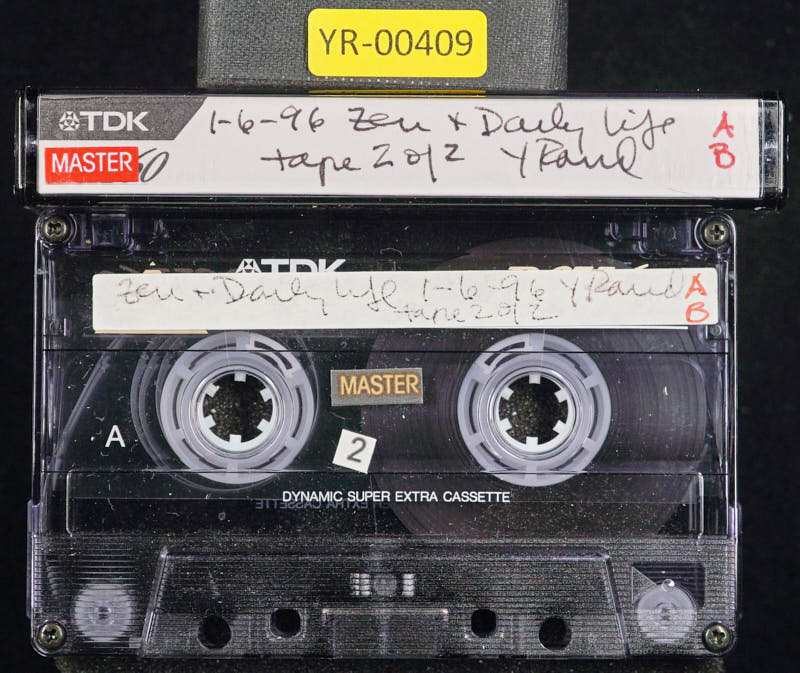

Side: AB
Possible Title: Zen & Daily Life
Additional text: Tape 2 of 2, Y Paul
@AI-Vision_v003
Recording starts after beginning of talk, Recording ends before end of talk
Continues talk that started on YR-00408
One of the hazards, I think, for us as practitioners is to think that we're going to arrive somewhere. And I think it's a kiss of death for anyone once you start teaching. If you don't continue being a student, you get into a lot of trouble. Every teacher I know who has self-destructed has self-destructed because they stopped having teachers. I see you nodding your head. I'm grateful. One of the promises I made to myself was that if I came to the point where I stopped being a student, I would have to stop teaching. I feel pretty strongly about it. I would like to do a little aside. I think you might find this interesting. Recently, I guess earlier part of December, my husband and I went to see the Vermeer exhibit.
[01:05]
in Washington, and then we went to see, before that, to see an exhibit of sculpture by Broncusi, which is at the museum in Philadelphia. Two artists I've been interested in for a long time. One of the things that I'm very interested in is to find expressions of the Dharma coming out of Western culture, because I think that's one of the challenges in having Buddhism take root in the West in some way that really resonates for us. And I think that Brancusi's sculptures are an instance of that. He's someone who, even though there are certain shapes that he made many sculptures of, each one was the first and only one he'd ever done. And he did each one with great patience and as a kind of meditation. And you sense that in his work.
[02:06]
I wasn't prepared for the effect on me of seeing the Vermeer paintings. The exhibit that's in Washington now is the biggest collection of his paintings that's ever been gathered. He's having his first retrospective some 300 years after he died. And I think he's completely a Dharma painter. He's particularly a Zen painter in that his subject matter is ordinary daily life. A woman sitting at a table writing a letter, a young girl with a pretty hat on her head, a young woman holding a pearl necklace in front of a mirror, someone looking out a window, A street scene. No big events. No big events. And there was a very moving editorial in the New York Times some weeks ago when the government shutdown first started.
[03:14]
And of course, along with the shutdown came the shutdown of the National Gallery. And there were all kinds of people who'd gone to see this collection of Vermeer paintings and couldn't get in. The effect of so much still serenity in one place can be quite overwhelming. The man who was the curator said that when he's done other shows that people have really liked, there's lots of excitement. But this show, people came up to him and said very quietly, thank you. But what was particularly striking was that the galleries themselves were very quiet, even though they were packed. W.H. Auden famously wrote that art makes nothing happen. Vermeer's art makes nothing happen over and over again, a kind of stilled breath inhaled, grace infused, and infusing nothing, which is at the root of everything that matters. William Carlos Williams, for his part, noted how it is difficult to get the news from poems, yet men die miserably every day for the lack
[04:20]
of what is found there. So this editorial writer said, Vermeer is essential, so essential, so close to the root of first things, decency, equanimity, free agency, fellow feeling, basic human regard. that perhaps the thing to do is to march the President, the Senate Majority Leader, the Speaker of the House, and the entire freshman class in Congress over to the National Gallery and to lock them inside the Vermeer Show and keep them there under its influence until they emerge with an agreement. So I thought to mention this to you because I think that one of the great opportunities we have as people who have an interest in a spiritual practice while living in the midst of the world is to find our temple in unlikely places, in surprising places, to be open to the possibility of being taught
[05:33]
by whoever or whatever arises in the midst of the lives we actually have. That attitude of willingness to be taught by everything and everyone transforms the possibilities of having a really rich spiritual life in the midst of the lives we have that mean going to work and taking care of our households and our families and our friends and our world. And so we have a real challenge because we can't any longer afford, I think, to make a real separation between our inner world and our outer world. We are destroying our world insofar as we make that kind of compartmentalization. If I drive on the freeway with some sense of the other people driving on the freeway with me, if I stand in line at the grocery store with some sense of interdependence, not only with what I'm buying to take home for the food for the family, but also for the other people standing in line.
[06:39]
And I see that as the occasion for the practice and cultivation of kind-heartedness. That little world called the grocery store changes and becomes the occasion for the kind of behavior that's very easy in a temple like this. And hopefully, because we have places like this where we can discover our capacities, we can then be inspired to continue carrying and developing those capacities in other perhaps seemingly less likely circumstances. There's a great... a teaching that His Holiness the Dalai Lama uses often, based on a great practitioner from the 9th century in northern India, from Nalanda University, who in his teaching talks about using our difficulties and our enemies as our opportunity and teachers for spiritual cultivation.
[07:43]
Because, of course, who else and what else will give us such wonderful opportunities for cultivating patience and equanimity and kindness and enthusiasm, even wisdom. And I think that attitude can open up the world that we live in in a very interesting and enlivening way. Every once in a while, one of my students will come and talk to me about some arch enemy they have, and I will suggest to them that they, if they can, clandestinely or otherwise, take a picture of that person and put it on their altar. This is, this week, my teacher. And there's usually a certain amount of groaning and foot dragging and you have to be kidding kinds of remarks. But of course, very quickly you begin to discover that this person that you think is driving you crazy is providing you with an opportunity to study your own mind strength.
[08:50]
and is probably a mirror anyway of some part of yourself that you don't like or just recently got over and don't want to be reminded of or whatever. Maybe in closing I can say a couple more things about language practices that you might enjoy. A friend of mine talks about pronoun disorder. You statements would fall into the category. Any statement in a conversation between me and another person, when I start saying, you do such and such, and you do such and such, and you always, and you never, I'm almost guaranteed to have that other person become quite defensive and on guard. If I stay with describing the only thing that I know with any kind of accuracy or with any kind of expertise, which is my own experience and my own state of mind, I can surprisingly often have a difficult conversation, that is a conversation about difficult matters, that doesn't happen when I'm talking to the other person about what he or she is or isn't doing.
[10:16]
And I think that this focus on our use of speaking in terms of you always and you never and you, you, you, helps us begin to see how often we go to try to get the other person to change instead of focusing on the one person I can actually get to change, which is myself. Now another part of pronoun disorder, our friend's suggestion about pronoun disorder, is more likely to happen for people who are couples. And that's the use of we. We loved the movie, for example. The use of we in that way can make it more likely that there is a kind of confusion and blurring about the distinction between two people, which allows us a kind of spaciousness in which we can have differences.
[11:20]
We don't have to be exactly alike. We can have different experiences of the same thing. And we can enjoy those differences without covering over the potential for conflict, which often that use of we is a way of controlling. We're not going to have any conflict here because we present a united front. So in terms of uncovering relational patterns that may not be so wholesome, paying attention to the use of these pronouns can be quite helpful. I also have a list of words I think of as red oil light words. Should, ought, always, never, try. I think of try. as what I say when I have no intention of doing something but I don't want to tell you so directly now.
[12:25]
I'll call you later when I'm sure you're not home and leave a message on your answering machine. I'll try to meet you for dinner tomorrow night. Should and ought are much more the red oil lights that have to do with being hard on ourselves, pushing ourselves, going to that realm that has to do with obligation, which is in many cases not examined. One time I saw a bumper sticker that said, don't should on me, which I thought was a great reminder. But that would be a focus that you might do with the Bear Noting practice, just to notice whenever you use should and ought. And let that be the occasion for checking in with, what's going on here? Am I trying to talk myself into something? Is this a way for me to have that habitual judging voice come in? I should be doing this.
[13:27]
Can often carry a kind of judgment. Now, one of the most important things, especially with these language practices, but I think this is true of other kinds of habitual behavior as well. In the beginning, you do not want to try to get yourself to change. You want to be initially willing to notice what you're doing. If you begin to notice what you do, you will then begin to notice what the consequences are of what you're doing. And that's really all you have to do. When you begin to see, if I do this, this happens, without a big court case, your behavior begins to shift. So keep in mind that the initial stage of this cultivation of awareness is intentionally not an effort to make you be different, but to help you cultivate your capacity to observe what's actually going on.
[14:38]
If you go too quickly to trying to fix it, that tendency to judge is much more likely to come in. Just stay with noticing. And a great deal of transformation happens almost on its own. Because of course with noticing comes a shift to allowing. And in that more spacious state of mind, change can occur. Is there anything you can think of that you would like me to speak to? Not now. Later. So it sort of seems like you're saying she would be an eternal student of yourself. Yes. I actually like the image of being an archaeologist and we're on an inner dig. A good archaeologist, that is an effective archaeologist, is not picky about what he or she finds.
[15:45]
Whatever shows up is interesting. I only want to see pots that aren't cracked or broken. I'm not going to get very far on most digs. You know, a little broken shard, a little dried turd, a little piece of hair. It doesn't matter what it is, it's interesting. I'm going to look at it and see what do I understand about this environment or whatever it is. And I think it's that mind of even interest, impartial awareness to whatever shows up is really what we're going for. And most of us get caught by, I only want to see what I want. I only want to see what I want and I don't want to see what I don't want. And we can go to extremes over that. I think unrequited love is an instance of, I'm only going to see what I want.
[16:46]
I fall in love with somebody who is absolutely clearly not in love with me, not even available. And I talk myself into, well, maybe he'll change his mind, or he just hasn't seen the real me yet, or he really loves me, he's just cool. It's self-deception. So to enter into that realm of self-deception, I have to be very dedicated to being an anthropologist, an archaeologist. But to be really dedicated to that always inquiring, inquiring, inquiring. I don't know if any of you know Oliver Sacks' writing. He's a neurologist. And he has a kind of insatiable curiosity. I think he's a closet Buddhist myself. He's insatiably curious about everything. And he, by his own definition, examines, examines, examines, scrutinizes, describes.
[17:50]
That's really what this whole process of mind training is about, is observing and describing. And if my describing is specific and particular, then I can begin to see, oh, this habit of mind leads to suffering. This patterning, this way of being leads to ease or happiness or equanimity. I also think that having some spiritual friends makes the journey possible. I think that this kind of way of working with the mind goes better when one has company. Other practitioners, people who have a little, some gradation of experience, can be the source of great encouragement, inspiration. to have a swim buddy.
[18:57]
Very often when I teach practices like this, I suggest to people that they pick someone in the class and call each other up once a week for five minutes just to say, well, how's it going? What's shown up? It's very helpful. It's very helpful. Thank you very much for asking me to come, and thank you all for coming this evening. And I hope that you'll pick one practice and try it. I'd like to thank you, Yvonne, for sharing with us your profound wisdom in Buddhism, in straightforward and simple language. I'd also like to thank Venerable Dhammo for sponsoring these talks. And I'd like to thank you for being here with Yvonne and us tonight. And I hope to see you next time on February 11th, that's Sunday, at 3 a.m. Thank you.
[19:58]
@Text_v004
@Score_JJ